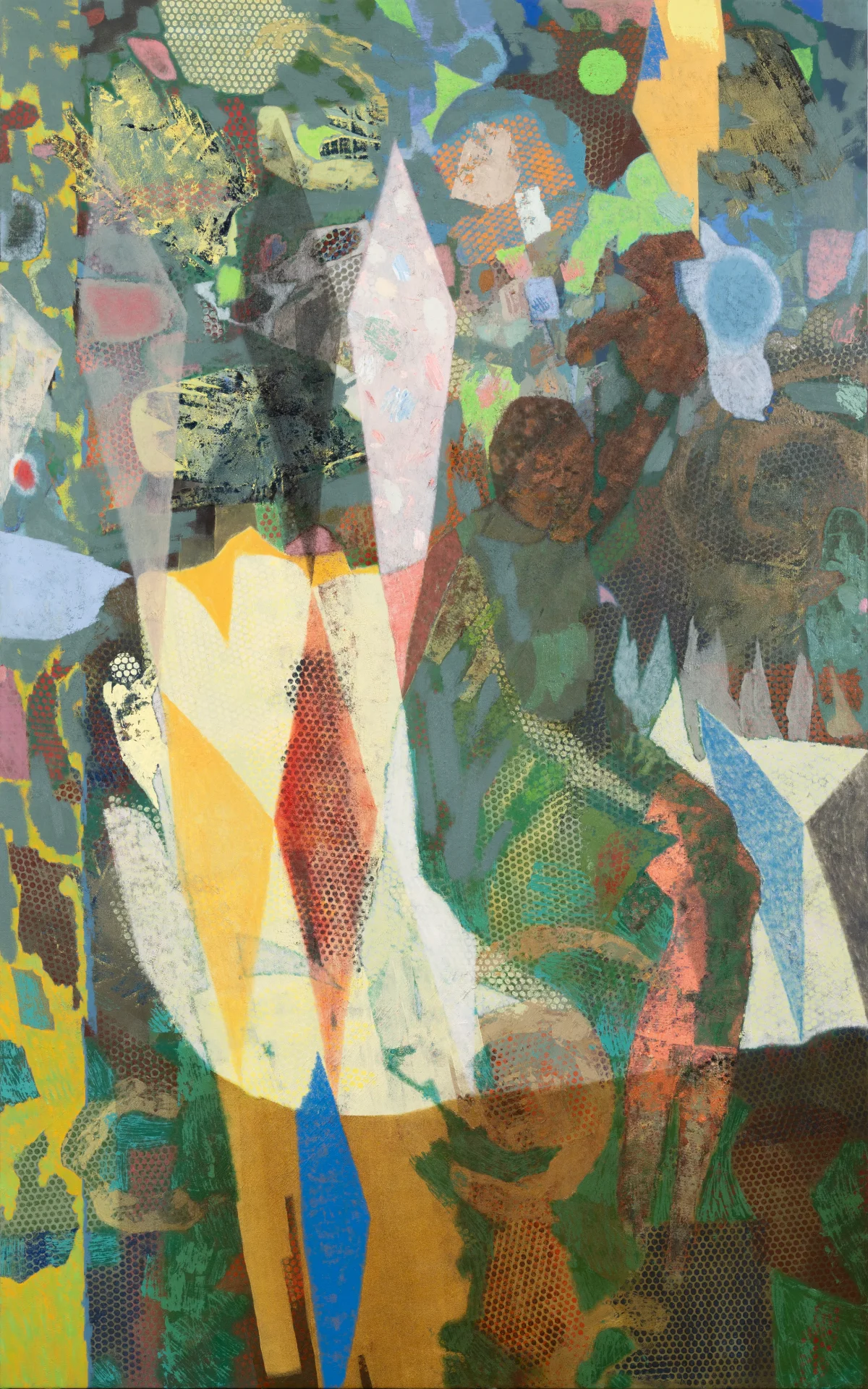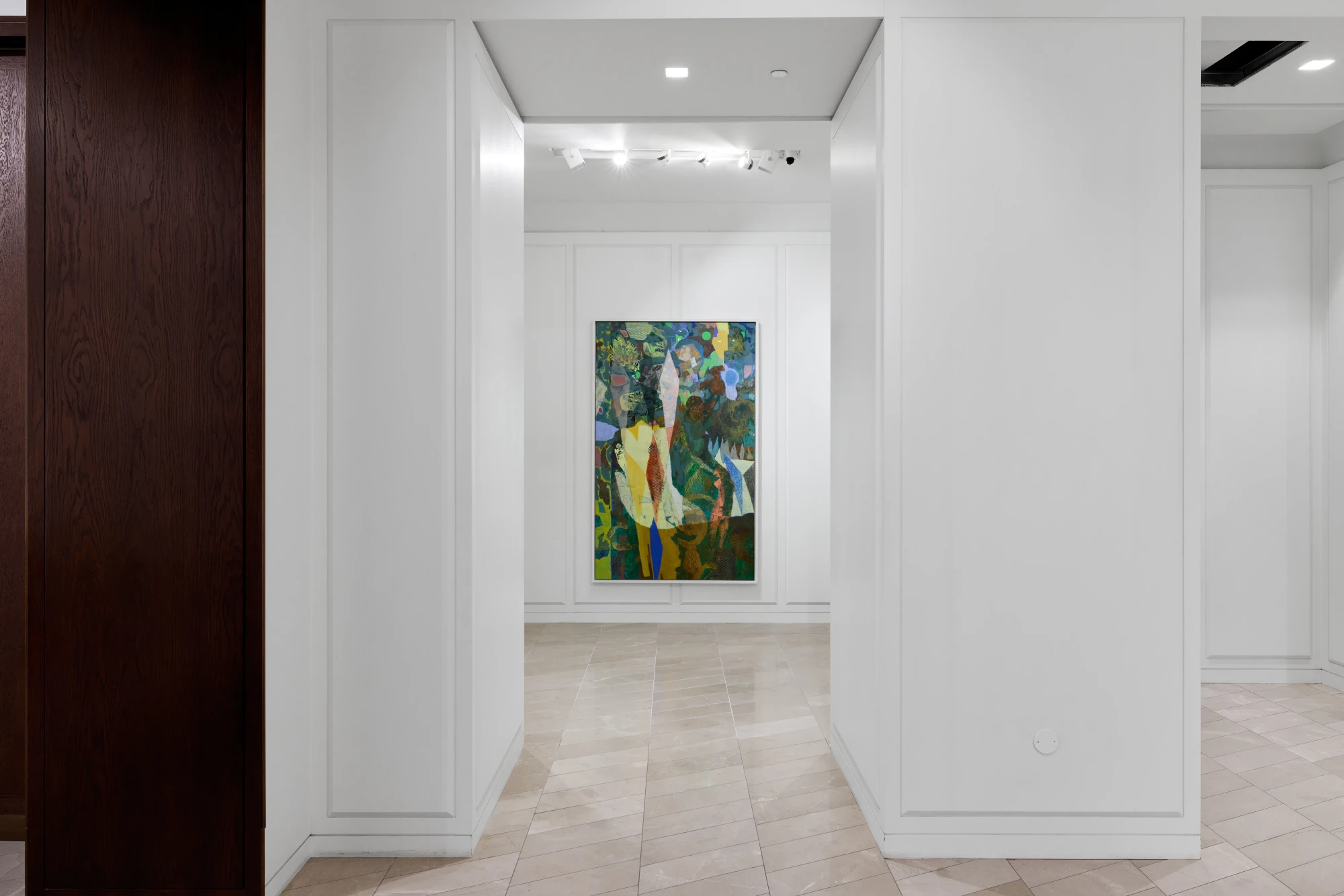
To the left of the last room, in a space of its own, hangs a single painting: Sverre Bjertnæs's Oljefondet (2026). It is a large oil, 210 by 130 centimetres, framed behind glass, and we have given it an intimate room with nothing else in it, so that it can be met slowly and on its own terms.
Bjertnæs is among the most accomplished Norwegian painters of his generation, and the surface rewards time. A deep green ground, shifting from forest to olive to turquoise, is worked over with fragmented, collage-like shapes in ochre, cream, rust and muted blue, with a tall off-white form near the centre acting as an anchor and a kind of opaque light. Half-figures emerge and recede without ever quite settling. The making mixes the hand and the machine: among the brushwork are fields of even dots, made by pressing bubble wrap into wet paint and peeling it away, so the picture flickers between something painted and something printed. The manner belongs to the style Bjertnæs has developed over the last decade in close dialogue with his late friend and mentor Håkon Bleken, and out of a shared love of the Norwegian painter Arne Ekeland.
The title does the rest of the work. Oljefondet , the Oil Fund, is what Norwegians call the sovereign wealth fund: the vast account built from the country's oil since 1969 and invested almost entirely abroad, by now so large that it owns a sliver of nearly every listed company on earth. It is the machinery behind the national self-image, the source of the comfort and, increasingly, the subject of an anxious national conversation: a weakening currency, wealthy citizens decamping for Switzerland, money that technically belongs to everyone yet sits untouchable somewhere offshore, saved for a future that never quite arrives. Oljefondet is one of three paintings Bjertnæs made around this language; the others, Den svake krona (The Weak Krone) and Arbeidende kapital (Working Capital), each borrow a phrase worn smooth by headlines and doomscrolling.
What makes the painting more than illustration is how little it explains its own title. There is no oil here, no fund, no obvious symbol. The link between the name and the canvas is deliberately loose, almost arbitrary, and that looseness is the point. Money is itself an abstraction, value dressed up as fact, numbers handed the authority of nature, and Bjertnæs lets the gap between a flat, bone-dry title and a dense, beautiful surface stand in for exactly that. It belongs to this summer for the same reason as everything else on view: it is about a polished public surface and the harder questions sitting underneath it. Reduced to its simplest, the painting asks two of them: whose money is it, and what is it for?